Your Future Job Is a Decision Inbox — Max Deichmann Built the Layer That Gets You There // Co-Founder @ Langfuse
Max Deichmann built Langfuse — the open-source LLM engineering platform acquired by ClickHouse — and explains why the engineer of the future isn't writing code, they're reviewing what agents did overnight.
Max Deichmann · CTO / Founder, Langfuse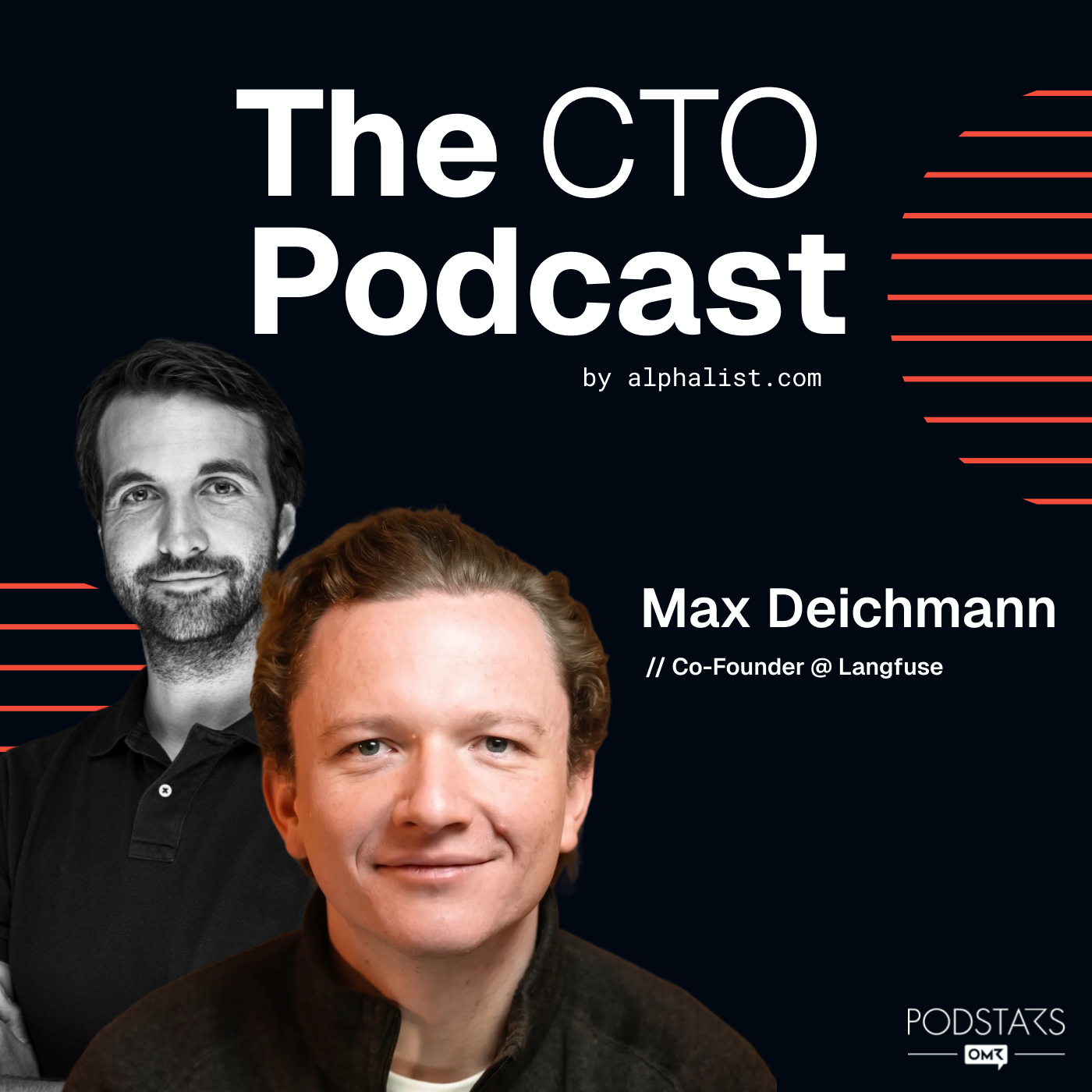
Max Deichmann, co-founder of Langfuse (acquired by ClickHouse), shares how his team built the open-source LLM engineering platform that became the observability layer for production AI agents and why the engineer's future job looks less like coding and more like managing a decision inbox.
The conversation covers the full stack of building and operating AI agents in production: pre-production testing, tracing, online evaluation, and the iteration loop that separates teams who are actually succeeding with agents from those chasing the hype. Max is unusually honest about where Langfuse itself still falls short, and what agentic workflows look like in practice, including copying 3am Slack alerts into Codex and waiting for the agent to start the investigation.
From the YC pivot that started it all to the half-page doc that led to the ClickHouse acquisition, this episode gives CTOs a grounded, no LinkedIn-filter view of where AI agents actually stand today.
Key topics:
- Why traditional observability tools fail for non-deterministic AI applications
- The Langfuse loop: pre-production testing, tracing, online evaluation, and iteration
- Open source as a go-to-market strategy: adoption without a sales team
- The ClickHouse acquisition: the two reasons that fit on half a page
- Agentic on-call: how Max's team handles incidents with Codex today
- The real state of agents in production, and where the hype still outpaces reality
Show notes.
Max Deichmann didn't set out to build the observability layer for the AI era. He started with mobile apps, taught himself to code via Harvard's CS50, and ended up in Y Combinator with a SaaS product he wasn't excited about. Then ChatGPT launched, and on a Sunday night at 10 pm, his co-founder asked: "If you just had time, what would you build?" The answer became Langfuse and eventually led to an acquisition by ClickHouse. This episode is a rare, grounded conversation about what building and operating AI agents actually looks like in 2025, from the engineering loop to the 3 am incident, to what the engineer's job becomes when agents are doing most of the execution.
Key topics:
- Why LLM applications broke traditional observability tools, and what Langfuse does instead
- The pre-production → production → evaluation → iteration loop for agent development
- Open source as a trust and adoption strategy for dev tools
- The ClickHouse acquisition: why they sold, what the half-page doc said, and how it's going
- Agentic incident response: copy-pasting alerts into Codex at 3 am, and what comes next
- The "decision inbox" engineers are reviewers and decision-makers, not coders
- The real state of agents in production: what's working, what's not, and what LinkedIn gets wrong
Timestamps:
[00:00:00] Intro & guest welcome [00:02:00] Max's nerd origin story CS50 on a beach in Singapore [00:04:00] Why they pivoted to Langfuse: firing customers mid-YC batch [00:06:00] Building the first AI products and discovering the observability gap [00:07:00] What Langfuse actually does: the LLM engineering platform explained [00:09:00] Tracking business AND infrastructure metrics billing via Langfuse [00:10:00] Open source from day one: trust, adoption, and hardening the product [00:13:00] Go-to-market with 1.5 salespeople: how engineers sell to enterprises [00:14:00] The acquisition story: 5 engineers, 40TB/day, and a Series A that became a sale [00:17:00] What it felt like when half the AI ecosystem knocked on their door [00:18:00] Life inside ClickHouse: cultural fit, Tokyo offsite, and what surprised them [00:20:00] Agentic coding in practice: velocity per engineer, what still needs a human [00:22:00] The planning loop: Claude summarising GitHub discussions, RFC → agent → review [00:23:00] The "decision inbox" model: engineers as taste-makers and reviewers [00:27:00] How to build an observability stack for the agentic era from scratch [00:29:00] Agentic on-call: the 3 am Codex workflow and what's coming next [00:32:00] Where Langfuse fits vs. traditional observability agent quality vs. infra health [00:35:00] The real state of agents in production: the non-LinkedIn version
Best quotes:
"We didn't initially jump on the topic because we thought all the PhD AI people, they are much better at this. We have no idea what's going on, until we figured out nobody has a clue what's going on." — [00:05:00–00:06:00]
"We have two guys doing customer support, and we have basically an agent that is doing first-level customer support for us, and I think it's about doing about 10,000 conversations a week. We would never be able to do this type of support with two people." — [00:38:00]
"The alert comes in, I wake up at the night, I just take the alert from our Slack, copy paste it into Codex, and we have a skill there with all the context, and then it's just going." — [00:29:00–00:30:00]
"I currently think of an email/Linear inbox where an agent tells me, 'Hey Max, we needed to fix this here because this broke.' And then if I want to, I can just dive into it and see all the context within this notification and also take a corrective course, or I just let it go." — [00:41:00]